


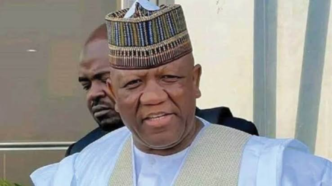
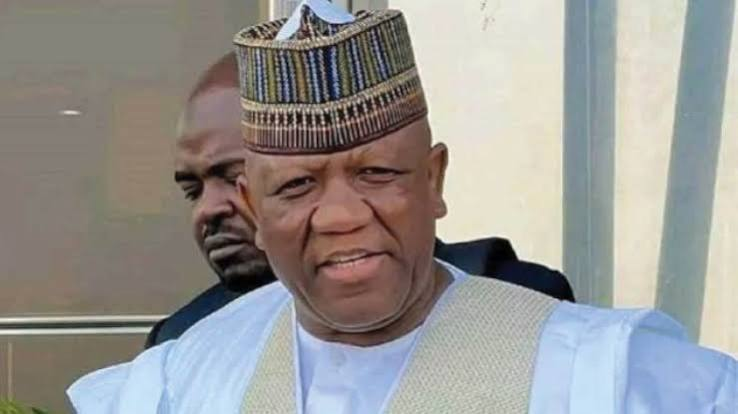
DIRECTOR-GENERAL of the All Progressives Congress Presidential Campaign Council, Abdulaziz Yari, has attributed Nigerians’ ability to put food on their tables to their willingness to work, raising questions about the government’s understanding of hunger and the affordability of basic necessities.
Yari made the remark at the APC presidential campaign rally in Uyo, Akwa Ibom State, on Friday, arguing that food was available in markets and that hardworking Nigerians should therefore be able to feed themselves.
His comments came amid widespread concerns over the cost of living, with food affordability remaining a major challenge for households struggling to meet basic needs.
The former Zamfara State governor acknowledged the existence of hunger but questioned whether residents of Akwa Ibom had encountered markets without food.
“Just as I said, we have hunger. Let me ask a question here. Akwa Ibom people, from where I came from, we have food in the market,” he said.
He subsequently suggested that people who were not lazy should have food on their tables.
READ ALSO: Eight Zamfara lawmakers dump APC over insecurity, 32-month salary arrears
“If there’s no food in the market, that’s what we are calling hunger. But anyone who is not a lazy person, definitely he would have food on his table,” Yari said.
But the distinction between food availability and food affordability is central to the hunger debate. The presence of rice, garri, beans and other staples in markets does not necessarily mean that households can afford to purchase them.
“A market may be adequately stocked while consumers lack the purchasing power to buy what they need,” said an Abuja-based economist, Dr Umar Abdulahi. “For many households, the challenge is not finding food but having sufficient income to pay for it.”
Related Articles
Yari’s argument effectively reduces hunger to an individual’s willingness to work, without addressing whether earnings are sufficient to cover food, transportation, housing and other essential expenses.
It also leaves unanswered how Nigerians who work regularly but earn low wages, operate small businesses or depend on irregular incomes are expected to cope with rising living costs.
The campaign official did not provide evidence in his remarks to establish that employment alone was sufficient to guarantee food affordability for Nigerians.
His comments also raise questions about the relationship between government economic policies and household welfare, particularly as the APC prepares to campaign on the performance of President Bola Tinubu’s administration.
READ ALSO: SBM: Nigeria faces fresh security threats as armed groups expand into new areas
APC defends economic record
Yari’s remarks followed his defence of the administration’s economic performance and appeal for Nigerians to give Tinubu another opportunity.
At an earlier campaign engagement in Ekiti State on Thursday, he challenged opposition parties to explain how their economic policies would differ from those of the current administration.
He said the APC intended to campaign on its achievements and economic performance, while asking Nigerians to judge the government based on its record.
“As we promised Nigerians, we are going to campaign with our numbers, with what we have done for Nigerians. Based on that, Nigerians, we requested them to give us a second chance,” he said.
Yari also cited what he described as a decline in food prices as evidence of the administration’s economic performance.
However, his comments in Uyo suggest that the campaign’s argument about food security extends beyond the availability of commodities to the question of whether Nigerians have enough income to purchase them.
READ ALSO: Geregu Power addresses concerns over failed bond repayment
For households facing difficult economic choices, the distinction is significant: food in the market does not necessarily mean food on the table.
The APC faces scrutiny over whether economic improvements claimed by the government are translating into affordable food, better incomes and improved living conditions for ordinary Nigerians.
“For Yari, who has been a governor of one of the states with high banditry and poverty, it is shocking that he would make such a callous statement. That is an insult on Nigerians,” said a Port Harcourt-based lawyer, Mr Daniel Jonathan.
The multidimensional poverty rate in Zamfara State is 78 percent, meaning approximately 8 out of 10 residents experience multidimensional poverty according to the National Bureau of Statistics’ 2022 data.
Yari was elected Governor of Zamfara State, Nigeria, in the April 26, 2011 national elections, running on the All Nigeria Peoples Party (ANPP) platform.
Corruption allegations
Yari’s successor, Bello Matawalle, created the Zamfara State Project Verification Committee led by Ahmad Zabarma to probe projects under Yari’s governorship. In February 2020, at the Committee interim report press conference, Zabarma announced that the Yari administration had spent a suspiciously inflated amount on incomplete or yet-to-be-started projects.
Zabarma claimed N3 billion was spent on the ongoing Zamfara State University project and N70 billion was spent on the House of Assembly renovation despite the University being only 30 percent completed and the House of Assembly renovation having not started at all. Zabarma also stated that N35 million was not refunded to Hajj pilgrims who could not be airlifted in 2012, over 1,000 vehicles belonging to the State Government (65 percent of its total vehicles) were missing after Yari left office, and N8.4 billion of state money was spent by Yari on exotic cars for associates and family along with several other cases of alleged corrupt practices using feeding programs, schools, water supply, and other projects.
Yari claimed political persecution by his successor, Matawalle, against himself and the Zamfara APC. Also in September 2020, Matawalle’s Finance Commissioner, Rabiu Garba, claimed Yari and an associate diverted N37 billion in refunds on federal projects away from state government coffers.
In February 2021, the Peoples Gazette reported that on the day before Yari left the Governor’s office, he wired N350 million to EFAB Properties Limited, a real estate developer based in Abuja. The EFAB account is also linked to Fabian Nwaora, a public works contractor and real estate developer.
In February and April 2021, Yari was detained and interrogated by the Economic and Financial Crimes Commission in connection with around N300 billion he allegedly attempted to move from a corporate bank account.
The Independent Corrupt Practices Commission also accused Yari of corruption, specifically embezzling money from the Zamfara State treasury. In January 2021, Yari lost a court case that approved the seizure of $669,248 and over N24.3 million from him with the judge siding with the ICPC’s argument that Yari was unable to explain the sources of the funds and thus the money was subject to forfeiture.
In February 2022, the ICPC won another case against Yari, this time for the interim forfeiture of 10 properties in Abuja, Kaduna, and Zamfara State along with Maryland in the United States of America. The judge stated that the interim order would last 60 days while the ICPC investigated further with the hearing on final forfeiture scheduled for April 28.