


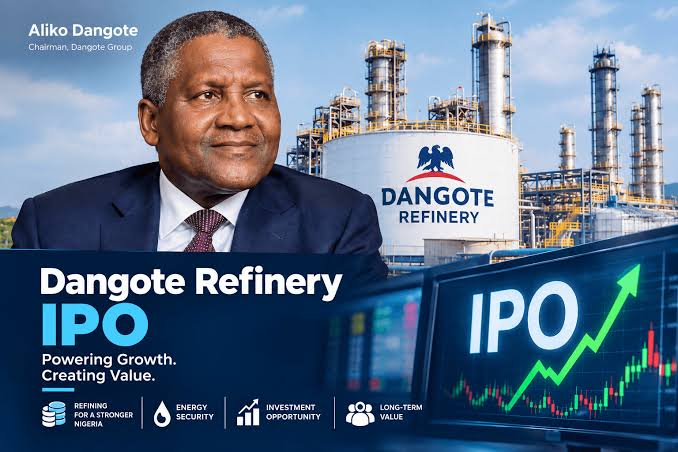
THE initial public offering of Dangote Petroleum Refinery and Petrochemicals is giving Nigerian investors access to one of Africa’s biggest industrial projects, but analysts and market watchers say the opportunity comes with significant risks ranging from valuation concerns to commodity-price exposure and continued control by the Dangote Group.
The $1.6 billion IPO, which opened on September 14, is seeking to raise about N2.15 trillion from investors and has been marketed as a ‘people’s IPO.’ with a minimum subscription of 10 shares at N525 per share.
The Securities and Exchange Commission (SEC) approved the offer and has urged investors to carefully study the prospectus and understand the risks before subscribing.
The refinery’s scale and recent financial performance are among the strongest arguments in favour of the offer.
The 700,000-barrel-per-day facility reported a $1.82 billion profit after tax in the first half (H1) of 2026, compared with a $476 million loss in the previous full year, according to its IPO prospectus as reported by Reuters. The refinery has also benefited from increased demand for refined products amid disruptions to global fuel supplies.
The upside: Exposure to major industrial asset
For investors, the IPO provides an opportunity to own part of a refinery that has changed Nigeria’s position in the regional petroleum products market.
The facility is increasingly supplying refined products to domestic and international markets. Its scale also gives the business potential to benefit from economies of scale if utilisation remains high.
READ ALSO: Dangote refinery targets US listing after 1.4m bpd expansion
Dangote Petroleum Refinery is also planning a major expansion. Management has outlined plans to increase capacity to 1.4 million barrels per day by 2029, while expanding into petrochemicals and other energy-related businesses.
If those investments translate into sustained increases in production, revenue and cash flow, shareholders could benefit through potential capital appreciation and future dividends.
Related Articles
The IPO could also give Nigerian retail investors greater exposure to the country’s industrial sector at a time when the domestic capital market is seeking to attract more individual investors.
The offer’s low entry threshold has already generated substantial interest. The minimum investment is N5,250 for 10 shares, potentially allowing people who have never owned equities to participate.
But valuation is a major concern
The biggest question facing prospective investors is whether the price adequately reflects the refinery’s future earnings potential.
The offer price is N525 per share, while reports based on the IPO documentation have put the refinery’s valuation at roughly $49bn-$50bn.
Some market observers have questioned whether such a valuation leaves enough room for further share price appreciation.
AP reported that one investor questioned whether the refinery would have to generate very substantial and consistent profits and cash flows to justify an even higher valuation from around N47tn.
That creates a key risk for investors as a strong company is not necessarily the same thing as a cheap stock.
If earnings growth fails to meet the expectations already embedded in the valuation, the share price could come under pressure after listing.
But a financial analyst, Mr Kalu Aja, has allayed those fears. “This is a great asset; 13 times is fair if earnings grow as imagined. Other refineries are often valued closer to 7–11 times in a normal year, and about 13.6 times only in a strong year,” he wrote on his X.
“This is not an asset you buy to flip after 6 months; the company is also offering a bonus if you hold for a year. This is a fully digital offer, meaning you can buy from all SEC-registered platforms.”
Related Articles
He further argued, “Two outside houses estimate 2026 profit at $3.8 billion and $4.1 billion. At those numbers, ₦525 is 12.6 times and 11.7 times. Still not a bargain, but close to fair if the strong half continues.”
READ ALSO: Dangote Refinery completes $2.5bn private placement as investor demand exceeds offer
Oil prices and refining margins remain risks
The refinery’s fortunes are also linked to conditions in the global oil market. Higher refining margins can boost profitability, while weaker margins could squeeze earnings even if the refinery continues operating at high capacity.
Recent geopolitical disruptions have benefited refiners by tightening global fuel supplies. But such conditions may not last indefinitely.
If Middle Eastern refining capacity returns, global fuel inventories recover and refining margins normalise, Dangote’s unusually strong recent profitability could moderate.
That means investors should be careful about extrapolating the refinery’s 2026 performance indefinitely.
Dangote will remain firmly in control
Another issue is ownership concentration. Dangote is retaining about 87 percent of the refinery after the IPO, according to AP. That means public investors will own only a minority stake and will have limited influence over major corporate decisions.
The arrangement offers investors exposure to the company’s growth but does not give them control over its strategic direction.
This is particularly important because the group has ambitious expansion plans, including doubling refining capacity and pursuing projects outside Nigeria.
Small free float could affect trading
The relatively small proportion of shares available to the public could also influence the stock’s behaviour after listing.
A limited free float can support strong demand when investor appetite is high, but it can also create liquidity challenges and potentially amplify price movements.
The IPO has already demonstrated the intensity of retail demand. Reuters reported that several Nigerian digital investment platforms experienced outages after investor traffic surged when the offer opened.
The episode demonstrates the scale of interest but also raises questions about whether Nigeria’s market infrastructure can comfortably accommodate millions of new investors.
READ ALSO: Dangote Refinery surpasses design capacity, hits 700,000 barrels in performance test
The bigger question for investors
The Dangote IPO presents a rare combination of scale, strong recent earnings and an ambitious expansion programme. Those factors could provide substantial long-term opportunities if the refinery maintains high utilisation, protects its margins and successfully executes its expansion plans.
But investors are buying into those future expectations at a valuation that has already attracted scrutiny.
The central investment question is therefore not simply whether Dangote Refinery is a strong business. It is whether N525 per share offers enough value after accounting for the refinery’s valuation, commodity-price exposure, refining margins, ownership structure and execution risks.
For Nigeria’s capital market, the IPO is potentially transformative. For individual investors, however, its popularity should not substitute for analysing the prospectus, valuation and risks before subscribing.
Analysts say it is a great investment, but not one without risks.
Debt levels
Bamboo Invest says that Dangote refinery was constructed at a reported cost of approximately $20 billion, financed through a combination of Dangote Group equity, private credit, and development finance institution loans. The firm wonders how much of that financing remains on the balance sheet as outstanding debt is not publicly known as of April 2026.
“Debt levels matter for several reasons. A highly leveraged company faces larger interest payments, which reduce earnings available for dividends. In a rising interest rate environment, refinancing of existing debt becomes more expensive. And in a commodity cycle downturn, high leverage amplifies the impact on earnings and the share price,” it adds.