

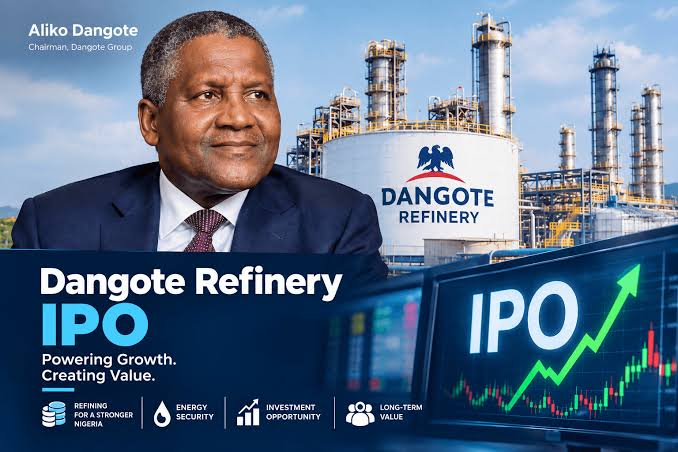
DANGOTE Petroleum Refinery and Petrochemicals reported a $4.73 billion net profit in the first nine months of 2026, reversing a loss recorded a year earlier, as investors get another two weeks to subscribe to its N2.15 trillion initial public offering.
The refinery’s earnings turnaround comes as it seeks to raise about $1.6 billion from the sale of 4.1 billion ordinary shares at N525 each, with the Securities and Exchange Commission (SEC) approving an extension of the offer deadline from October 13 to October 27.
The latest financial results provide investors with a fresh basis for assessing the company’s earnings potential, although the figures are unaudited and the sustainability of its recent profitability remains a key consideration.
According to the company’s results released on Tuesday, revenue rose to $22.48 billion in the nine months to September 2026 from $9.19 billion in the corresponding period of 2025.
The refinery had recorded a net loss of $117.2 million in the previous year’s comparable period.
Earnings before interest, taxes, depreciation and amortisation (EBITDA), a measure of operating profitability, climbed to $5.52 billion from $627.6 million, while operating cash flow increased tenfold to $3.68 billion from $364.7 million.
The company also moved from a net debt position of $1.73 billion a year earlier to net cash of $650.8 million. Its cash holdings stood at $6.69 billion at the end of September.
Chief Executive Officer, David Bird, attributed the performance to the refinery’s transition from commissioning and ramp-up activities to more established commercial operations.
“Our third-quarter performance demonstrates the successful transition from commissioning and ramp-up activities to sustainable commercial operations,” he said.
READ ALSO: NGX CEO: Dangote refinery IPO could trigger fresh wave of listings
Related Articles
Strong earnings reshape IPO investment debate
The earnings surge could strengthen the investment case for the refinery by demonstrating its ability to generate substantial revenue and profits after the expensive construction and commissioning stages.
However, the results also raise questions about how much of the exceptional performance can be sustained once market conditions normalise.
The refinery benefited from increased demand for refined petroleum products and supply disruptions linked to the Iran war, which helped it sell jet fuel into Western Europe.
Such conditions can improve refining margins by tightening product supply and raising prices, but they may not persist indefinitely. A moderation in geopolitical tensions, changes in crude oil prices or weaker refining margins could affect future earnings.
Investors will therefore need to distinguish between profits supported by improved operational efficiency and those influenced by unusually favourable market conditions.
The company’s unaudited results also mean investors should examine the detailed financial statements, cash-flow performance and underlying costs before drawing firm conclusions about its long-term earnings capacity.
IPO extension gives investors more time
The refinery’s offer comprises 4.1 billion ordinary shares priced at N525 each, giving the transaction a value of approximately N2.15 trillion if fully subscribed.
The company has said subscriptions exceeded its original fundraising target by more than three or four times, although it has not published an exact subscription figure confirming the amount received.
Multiplying the offer value by four produces an estimated N8.61 trillion, but this remains a calculation based on the reported subscription multiple rather than an officially confirmed total.
The extension, according to the company, is intended to give more eligible investors across Africa an opportunity to participate rather than to raise additional funds.
Related Articles
READ ALSO: Dangote refinery IPO offers huge upside, but investors face risks
It also gives prospective shareholders more time to complete account-opening, identity-verification and other regulatory requirements.
The refinery is targeting as many as 10 million retail investors, an ambition that could widen public ownership of one of Africa’s largest industrial assets.
African ownership ambition faces practical hurdles
Despite reported investor enthusiasm, the offer has exposed difficulties in attracting capital across African borders.
The prospectus indicates that the public offer was not registered outside Nigeria, meaning investors in other countries must navigate their local regulations and rely on eligible investment platforms or approved intermediaries.
Differences in securities rules, payment systems and brokerage access have complicated participation, potentially limiting the number of investors who can subscribe from outside Nigeria.
The additional two weeks could help address some distribution and administrative challenges, but the extension alone will not resolve the wider fragmentation of African capital markets.
The final subscription figures should therefore reveal whether the refinery has succeeded in broadening ownership geographically, rather than simply attracting large sums from investors already able to access the Nigerian market.
READ ALSO: Dangote refinery targets US listing after 1.4m bpd expansion
Expansion plans raise stakes for shareholders
The 700,000-barrel-per-day refinery is seeking public capital to support its expansion plans, including an ambition to increase capacity to 1.4 million barrels per day by 2029.
Related Articles
Equity financing could provide funding for expansion without relying exclusively on additional borrowing. The company’s improved cash position could also give it greater flexibility in financing operations and investment.
However, raising equity means sharing future earnings and ownership with new shareholders. The benefits will depend on how effectively the company deploys the proceeds and whether expansion generates returns that justify the capital raised.
The offer also carries risks for retail investors. Strong recent profits do not guarantee future dividends or share-price gains, while changes in crude prices, foreign-exchange movements, operating costs, taxes and refining margins could affect financial performance.
Investors must also consider the price they are paying relative to the refinery’s sustainable earnings, liabilities and future capital requirements.
October deadline puts focus on value, not just demand
The IPO is emerging as a test of whether Nigeria’s capital market can mobilise domestic savings to finance a major industrial enterprise while attracting investors from across the continent.
The refinery’s latest results strengthen the financial narrative behind the offer, but the final assessment will depend on more than the scale of subscriptions.
Investors will need to see whether the company can sustain profitability, generate cash consistently, execute its expansion plans and provide shareholders with adequate returns.
The offer is scheduled to close on October 27, with the company’s revised timetable indicating that allotment and listing preparations will follow in November, subject to regulatory approvals and the completion of the relevant processes.
“For Dangote Refinery, the immediate challenge is to convert its earnings momentum and reported investor interest into a successful public offering. For investors, the more important question is whether the refinery’s current profitability can support its valuation over the long term,” said an emerging markets analyst, Dr Ike Ibeabuchi.
Related Articles