



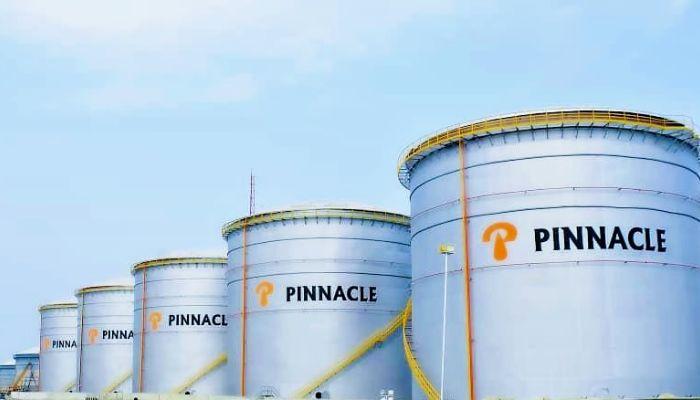
Pinnacle Oil and Gas Limited has reportedly imported a 60,000-metric-tonne cargo of petrol into Lagos, as the debate over continued fuel importation intensifies amid growing domestic refining capacity.
We gathered that the petrol cargo was brought into Nigeria aboard Flagship Sage, a 2011-built tanker with IMO number 9471329, which is currently discharging at Pinnacle’s Single Point Mooring (SPM) in Lekki, Lagos.
The development occurred on Thursday, October 1, 2026, with the vessel’s discharge operation continuing into Friday October 2, 2026, according to vessel-tracking information.
The vessel, which was chartered by global energy giant BP, loaded the 60,000 metric tonnes of regular gasoline at the Sea-Tank Terminal in Antwerp, Belgium, before sailing for Nigeria.
According to voyage records, Flagship Sage arrived at the Sea-Tank Terminal in Antwerp on September 4, 2026, where the gasoline-loading operation was recorded. The vessel subsequently left Antwerp on September 11 at about 3:55pm, beginning its voyage to Lagos. Flagship Sage arrived in the Lekki area on September 26 at about 3:59am, with the voyage record showing Lekki, Nigeria, as its destination.
The vessel was subsequently recorded at the Dangote Petroleum Refinery and Petrochemicals on September 29 at about 3:54pm, before proceeding to its current operation involving the discharge of the imported gasoline at Pinnacle’s SPM.
As of October 2, 2026, vessel-tracking information showed Flagship Sage as moored and discharging, with its latest AIS position recorded at 8:09am on September 30 in the supplied tracking record.
After completing the gasoline discharge, the vessel has been fixed to load another 60,000 metric tonnes of Jet A-1 aviation fuel at Pinnacle’s SPM.
The latest import comes against the backdrop of the emergence of the Dangote Petroleum Refinery and Petrochemicals as a major supplier to Nigeria’s domestic petroleum market.
The refinery, located in the Lekki Free Zone, Lagos, has crude distillation capacity of about 700,000 barrels per day. It produces petrol, diesel and Jet A-1, among other refined products, while its integrated petrochemical plant has a stated capacity of 830,000 tonnes per annum of polypropylene.
The refinery has increasingly supplied petroleum products to the Nigerian market while also exporting refined products.
Data cited by the US Energy Information Administration showed that intra-Nigerian petroleum product shipments reached 211,000 barrels per day in the second quarter of 2026, compared with 81,000 bpd in 2025 and 33,000 bpd in 2023.
The same data showed that Nigeria’s seaborne petroleum product imports had fallen to less than 130,000 bpd in the second quarter of 2026, from nearly 400,000 bpd in 2023, while exports increased substantially following the ramp-up of the Dangote refinery.
The development has strengthened calls from domestic refiners for a reduction in petroleum product imports, particularly as local refining capacity continues to expand.
Refiners push against imports
Speaking at the 3rd Nigeria Oil Refining Summit in Lagos, President of the Crude Oil Refinery Owners Association of Nigeria, Momoh Oyarekhua, called for the progressive reduction of petroleum product imports, with imports increasingly restricted to objectively determined domestic supply shortfalls and strategic-stock requirements.
Oyarekhua said Nigeria needed to increasingly use its crude oil to feed domestic refineries rather than export crude and import refined petroleum products.
He also called for full implementation of the Naira-for-Crude policy to strengthen local refining.
The refinery owners’ position is that continued large-scale imports could weaken the competitiveness of domestic refineries and undermine incentives for further investment in local refining as Nigeria’s refining capacity grows.
The latest petrol cargo therefore arrives at a critical point in Nigeria’s downstream petroleum sector, with refiners pushing for a gradual reduction in imports while oil marketers continue to defend access to imported products