


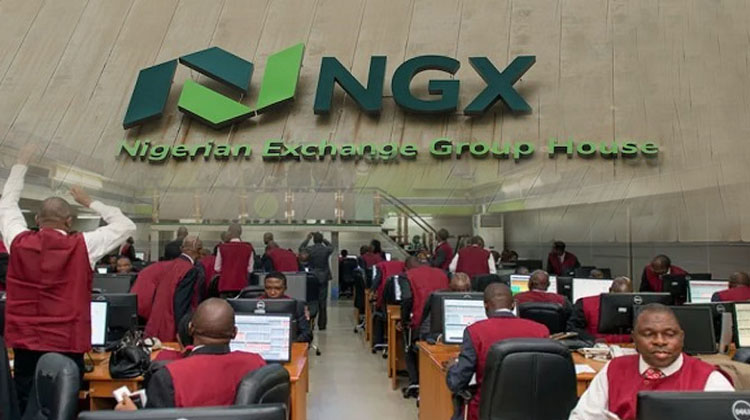
THE Nigerian equities market extended its losing streak to six sessions on Wednesday as renewed selling pressure on banking and other major stocks pushed the benchmark index lower.
The NGX All-Share Index fell 176.75 points, or 0.07 percent, to close at 250,096.75 points, compared with 250,273.50 points recorded in the previous session.
The decline translated into a N110.16 billion reduction in the market’s total value, which ended the session at N162.39 trillion.
Trading activity remained substantial despite the weaker market, with investors exchanging 446.91 million shares in 38,808 deals.
However, volume fell 22.83 percent from the 579.17 million shares traded on Tuesday, while the number of deals declined by 5.30%.
Banks bear the brunt of selling
The banking sector was the biggest drag on the market as the NGX Banking Index dropped 0.36 percent to 2,644.49 points.
Several major lenders recorded losses, including Wema Bank, which fell 3.02 percent to N30.55; Ecobank Transnational Incorporated, down 1.47 percent to N67; United Bank for Africa, which declined 1.22 percent to N44.50; and Access Holdings, down 0.99 percent to N30.
Guaranty Trust Holding Company also lost 0.75 percent to close at N131.50. The losses came despite continued heavy activity in financial stocks.
Zenith Bank accounted for 34.90 million shares, Access Holdings recorded 25.28 million shares, while Sovereign Trust Insurance and Critical Minerals Financing Corp traded 24.37 million and 32.76 million shares respectively.
Zenith Bank was among the few major financial stocks to gain, rising 0.22 percent to N135.80, while Stanbic IBTC Holdings advanced 1.11 percent to N163.90.
Related Articles
READ ALSO: FTSE Russell names 10 Nigerian stocks eligible for frontier indexes
Oil, consumer stocks also weigh
Weakness was not limited to banks. The NGX Oil and Gas Index slipped 0.09 percent, with Oando falling 3.23 percent to N33.00. Seplat Energy was unchanged at N16,000.10.
The Consumer Goods Index also declined 0.08 percent, as Dangote Sugar Refinery fell 2.14 percent to N68.50 and PZ Cussons Nigeria dropped 1 percent to N69.
Transnational Corporation was another notable decliner, falling 2.67% percent. The pressure on large-cap stocks helped keep the broader market in negative territory despite gains recorded by several smaller companies.
Insurance stocks buck downward trend
Insurance was one of the few sectors to resist the broader selloff. The NGX Insurance Index edged up to 1,093.69 points from 1,093.41 points, supported by strong gains in Coronation Insurance, Guinea Insurance and Regency Alliance Insurance.
Coronation Insurance gained 9.24 percent to N2.60, Guinea Insurance rose 6.85 percent to N0.78, while Regency Alliance advanced 2.78 percent to N0.74.
READ ALSO: Nigerian stocks still offer strong value despite market correction, says expert
Their gains helped offset a 7.60 percent decline in Sovereign Trust Insurance to N2.31.
The Industrial Goods Index was also broadly stable, rising marginally to 10,440.80 points.
Dangote Cement remained at N1,066.70 while BUA Cement closed at N297.00. Cutix and Tripple Gee recorded stronger gains of 2.09% and 9.96% respectively.
Related Articles
Market breadth remains mixed
The session showed that investors were still selectively buying some stocks even as they reduced exposure to several large companies.
Champion Breweries gained 9.50 percent to N10.95, Multi-Trex Integrated Foods rose 8.33 percent to N0.39, while Cadbury Nigeria advanced 2.93 percent to N59.70.
At the other end, Thomas Wyatt Nigeria suffered the biggest decline, falling 9.74 percent to N2.41. Sovereign Trust Insurance dropped 7.60 percent, followed by Livingtrust Mortgage Bank, which declined 7.25 percent.
The Main Board accounted for 325.56 million shares traded in 24,440 deals, while the Premium Board recorded 90.61 million shares in 11,580 deals.
READ ALSO: Banking stocks lift NGX turnover to N152bn as market cap edges higher
The continued weakness in the All-Share Index suggests that investors remain cautious, with profit-taking in major banking, consumer and energy stocks outweighing buying interest in selected gainers.
The six-session decline also comes despite relatively strong turnover, indicating that market participants remain active but are increasingly selective about where they deploy funds.